At a glance
What it does
A floating, flip-over task board for monitoring and organizing the current DeepSeek Harness web session.
Web Profile
Not declared in supplied evidence
Evidence-verified
Checked Sep 16, 2026, 2:12 PM UTC
Code-evidenced contributions
What it adds to DSH
Adds a flip-over glass board for the current DSH session, with job, subagent, workspace, and plugin views plus editable cards and a canvas.
Mechanism evidence ↗Before you choose it
This DSH web client plugin adds a glass task console behind the current session page. It shows live background jobs, subagents, session and workspace details, and dynamic plugins; it also supports draggable persistent cards, taskcard blocks from conversations, an infinite canvas, and optional relay-based collaboration.
Best for
DeepSeek Harness web users who want a visual workspace for a session's activity and lightweight task cards.
Common tasks
- Check current-session jobs, subagents, workspace details, and plugin status.
- Create or update persistent checklist, progress, note, link, and other declarative cards from chat messages or the card editor.
- Arrange copies of user cards on a local infinite canvas; optionally share a canvas through a self-run relay.
Permissions and data
Runs as a DSH web client plugin and stores interface state locally; some optional features connect to external content or a user-operated relay.
Permissions- Injects into DSH web client slots and dynamic plugin facilities.
- Can create a temporary DSH agent session when using card refactoring.
- Stores cards, layout, widget state, and canvases in browser localStorage.
- Canvas share strings may include a relay address, canvas ID, and optional token.
- Optional embedded frames load user-supplied HTTP(S) sites.
- Optional multi-user editing connects to a WebSocket relay started separately by the user.
- No package credential requirement is declared.
- The optional relay uses a bearer token when configured.
Limitations
- Requires a DSH web profile, Node.js 20 or later, and React 18 as a peer dependency.
- The supplied evidence does not declare a DeepSeek Harness version range.
- Sites that prohibit framing through CSP or X-Frame-Options may appear blank in embedded cards.
- The optional relay is a separate process; concurrent edits to the same canvas card use last-writer-wins behavior.
What DSHub checked
- The pinned Git source, package structure, DSH bundle patch, MIT license, Node.js engine, and React peer dependency were captured.
- The bundle patch identifies the web profile integration and DSH plugin installation command.
What DSHub did not check
- Installation, restart/reload behavior, browser UI behavior, agent-session behavior, relay operation, and test scripts were not executed in the supplied evidence.
- The npm registry package version was not found in the supplied evidence.
Pinned install
Install DSH Task Console
This plugin bundle does not have a DSH Plugin install action. Use its source documentation for the delivery method.
Maintainer source
Project README
dsh-task-console

A DeepSeek Harness (DSH) client plugin: a floating glass task console for the current session. Click the glass button in the bottom-right corner and the page "flips" to its back — a frosted-glass board with mouse-draggable cards showing live background jobs, subagents, a session overview and the workspace.
一个 DeepSeek Harness (DSH) 客户端插件:为当前会话提供悬浮毛玻璃「任务控制台」。点击右下角的玻璃按钮,页面翻到背面 —— 一块毛玻璃面板上悬浮着可鼠标拖拽的卡片,实时展示后台任务、子代理、会话概览与工作区。
Features / 功能
- Flip to the back / 一体两面翻面 — a floating glass toggle (
⇄ 任务台, fixed bottom-right) flips the whole main interface over around the page's vertical center axis: the real session page is the front face (it visibly turns away) and the frosted-glass task board is the back face (it turns into view) — one body, two faces. A silky ease-in-out 180° flip with no end wobble; a light sheen glides across the glass and the cards rise in staggered as the board lands; closing flips the page back. Respectsprefers-reduced-motion;返回会话orEscflips back. - Floating composer / 统一悬浮窗 — the REAL conversation input bar stays put while the page flips: its seat (
[data-composer-seat]) is switched to fixed positioning (never moved out of#root), so typing, attaching and sending keep working over the task board. As the page turns, the input bar morphs into the floating window (grows from the visible input card, glass fades in); on close it morphs smoothly back to the same spot (title bar and transcript come off first so the shrinking box never clips). The home rect is the visible box — the input card (plus its padding) for a live conversation, the hero stack for the new-session welcome — never the seat's full-column box, so the window never stretches wide and the final restore lands on the identical box: no snap, no fade-out. The new-session welcome reverts smoothly on close too — the compact title grows back, the glow fades in and the layout settles via transitions. The chat scrollport is put into smooth-behavior mode around the restore and its pre-flip state is remembered, so every programmatic scroll — including the chat view's own pinned-follow — glides the history into place instead of jumping when the composer re-enters the flow. Both the active conversation and the new-session welcome open as one unified water-glass floating window with the same initial size (440×480): a title bar on top, the brief live transcript (last few messages, role chip + truncated text, refreshed as you chat), and the real input with its full option bar (permission config, command menu, model seat, context meter) at the bottom. The window is draggable by its top bar and resizable by its bottom-right corner (320–viewport limits). The new-session window shows its welcome title header, workspace chip and input instead of the transcript. While the board is open, body-level portaled menus (workspace picker, command menu, …) are lifted above the board so every button stays clickable. - Live current-session data / 当前会话实时数据(来自 DSH 的
useSessions标准数据源):- 会话概览 Session — title, running/idle, phase, origin, live job & subagent counts.
- 后台任务 Jobs — live background jobs: status dot, kind chip, label, status, ticking durations (live jobs first).
- 子代理 Subagents — the session's subagent catalog: child/fork, running/idle, id.
- 工作区 Workspace — cwd, session id, last update time.
- 插件管理 Plugins — the frame-wide dynamic Cordis inventory: each plugin's name, running/stopped state, and actions (停止 / 移除 with a two-step confirm), refreshed automatically on the dynamic-plugin events (
cordis/dynamic-package, retract, run requests).
- Draggable & resizable glassmorphism cards / 可拖拽、可缩放毛玻璃卡片 — hold a card header and drag (pointer capture, clamped to the board); the grabbed card is raised by direct DOM z-order while dragging, and drag the bottom-right corner to resize any card (220–900px wide, 120–1200px tall, clamped to the board); every card can be collapsed (
▴/▾); user cards can be pinned on top (📌); built-in cards can be hidden (×); positions, sizes and state persist inlocalStorage(dsh.taskconsole.v1);复位卡片restores the built-in layout while keeping your user cards. Gestures are compositor-driven and render-free while the pointer is down: pointer moves apply a transform (or an inline size) inside arequestAnimationFrame, the moved card drops itsbackdrop-filterfor the duration (every other card keeps its normal look), grabbing no longer triggers a board re-render, and React state +localStorageare committed exactly once on release. Card bodies are memoized, and once the flip settles the rotated front face is culled (visibility+content-visibility: hidden) so the compositor only handles the board. - Infinite canvas & live collaboration / 无限画布与多人协作 —
🖼 画布in the board header opens a fullscreen infinite canvas (wheel zoom anchored at the pointer, drag empty space to pan,复位视图to recenter); any user card publishes an independent copy onto it with📤. Canvas cards move/resize freely and keep the whole pipeline: control blocks, widget state,✎manual editing and💬agent refactor. Images can be dropped or pasted onto the canvas (downscaled to a bounded JPEG and stored as animagecontrol). Canvases are named, switchable and kept per browser (dsh.taskconsole.canvas.v1);复制分享串emits aDSHCANVAS1:…string carrying the relay URL + canvas id + optional token, and协作 → 加入adopts it. Multi-user editing runs over the zero-dependency relay shipped inrelay/server.mjs(node relay/server.mjs --port 8787 --token <secret>): a joiner receives the room snapshot, every card mutation is broadcast, presence is shown in the canvas bar, and conflicts resolve last-writer-wins per card (updatedAt, thenrev). See infinite canvas & collaboration. - User cards you add / edit / delete / 自定义悬浮卡片(新建 / 编辑 / 置顶 / 删除) — the board header's
+ 新建卡片creates a blank draft card and auto-opens the conversation popup at the top-right, where you describe the card's style and internal controls in language and the assistant shapes it;✎still offers manual editing of text + buttons; each user card carries📌置顶 /📤发布为副本 /💬对话修改 /✎编辑 /🗑删除(两次点击确认); the five built-in cards (session/jobs/subagents/workspace/plugins) stay read-only. Cards, positions, styles and states survive reloads inlocalStorage. - Cards authored in the conversation / 对话生成卡片(内容高度自由) — no copy/paste needed: while you chat (in the floating main-session window over the board, or in any conversation), an assistant/user message that contains a
[taskcard]…[/taskcard]block is watched live and applied to the board (create / update / delete). The AI decides the card's content freely and picks the right controls for the need — text, headings, notes, stats, progress, trends, key-values, tables, code, links, tags, images, checklists, counters, toggles, countdowns, bar charts, action buttons and embedded web apps — see the card protocol. - Associate other web apps with a card / 卡片关联内嵌网页应用 — a card can host other web applications as sandboxed frames: the manual editor (
✎) has an 内嵌网页应用 section (address, name, height, 填满卡片, test-open ↗) and a conversation can author the same thing with anembedcontrol ({ "kind": "embed", "url": "http://localhost:5173", "title": "本地应用", "fill": true }). Only absolutehttp(s)URLs are accepted —javascript:,data:,file:andblob:never reach the frame; the URL is normalized throughnew URL(). Drag the app's bottom edge to size it: the frame follows your pointer (the live pixel value is shown while dragging) and the height is committed once on release — measured in layout pixels, so it stays exact even inside the zoomed infinite canvas. Each app also gets a small bar with reload (↻), open-in-new-tab (↗) and copy-address (⧉);fill: truemakes the app take the card's remaining height instead (resize the card itself), so one card can be a whole app window — or mix an app with notes, buttons and other controls (up to 4 apps per card). Frames are sandboxed withoutallow-top-navigation(an embedded app can never navigate the workbench away), and a same-origin address (this GUI itself) is re-framed with an opaque origin so the embedded copy cannot script the workbench. Apps keep their own cookies/storage/logins and run their own JS; sites that refuse framing (X-Frame-Options/CSP) show blank — use↗. Embeds travel with the card when it is published to the canvas. - Refactor a card by talking / 💬 对话重构卡片 — every user card carries a
💬button (and+ 新建卡片auto-opens it) with a top-right conversation popup: describe the change in natural language and send. The plugin calls a temporary agent session, streams that agent's reply into the popup, parses its[taskcard]block and applies it to the card (including deletion); the helper session is archived afterwards and the main conversation is left untouched. The helper is a fresh blank session created in the source session's workspace (or cwd), so it inherits neither that conversation's history nor its agent inbox;session.forkremains only as a fallback whencreateis unavailable, and that path drops inherited queue items and stops a stale inherited turn before prompting. The reply is read from the helper session's own event window (durableassistant/messageevents plus its streaming rows) — session snapshots carry lifecycle state only — and only after the instruction itself shows up there as a user message. If the agent services are unavailable it falls back to sending through the current main session, and the popup says why. - Right-hand architecture diagram / 右侧项目逻辑框图 —
🗺 框图in the board header docks the project's own architecture diagram against the right edge of the board (drag the left edge to change its width; the width is remembered). The diagram is an archify artifact (docs/architecture.html, generated fromdocs/architecture.json) that ships inside the client bundle — gzipped + base64 (tools/embed-diagram.mjs), decompressed on first open withDecompressionStreamand rendered in a sandboxediframe(srcdoc), so there is no extra file or network request. Inside the dock the diagram stays fully interactive (zoom, click nodes, light/dark, export);新标签打开opens the same artifact full-screen in a new tab. See architecture diagram. - Theme aware / 明暗主题自适应 — follows the DSH theme (
data-ds-dark-theme), respectsprefers-reduced-motion.
Install / 安装
Requires a DSH profile (default: web). The package declares dsh.bundle, so dsh plugin wires it into the profile's bundle list automatically — no manual patch editing.
需要 DSH profile(默认 web)。本包声明了 dsh.bundle,dsh plugin 会自动把它加入 profile 的 bundle 列表,无需手动改 patch。
From npm / 从 npm 安装(发布后)
dsh plugin --profile web add dsh-task-console
From GitHub / 从 GitHub 安装
dsh plugin --profile web add git+https://github.com/He2way/dsh-task-console.git
If pnpm blocks the build of a git-hosted dependency, add the exact key pnpm prints under
allowBuildsin$DSH_HOME/profiles/web/pnpm-workspace.yaml, then re-run. 若 pnpm 阻止 git 依赖的构建,把 pnpm 打印的 key 加到$DSH_HOME/profiles/web/pnpm-workspace.yaml的allowBuilds下,再重跑一次。
Then restart the dsh web process (or reload the profile) so the new loader row mounts and the browser bundle is composed into window.__DSH_BOOT__. Hard-refresh the page (Ctrl+Shift+R).
然后重启 dsh web 进程(或重新加载 profile)使新 loader 行挂载、浏览器 bundle 进入启动清单,最后强制刷新页面(Ctrl+Shift+R)。
Usage / 用法
- Click the floating glass button
⇄ 任务台(bottom-right). - The page flips to the back — the glass task console for the current session. The button stays at the bottom-right, so click it again (now
◀ 返回正面) to flip straight back; the conversation input bar also stays put at the bottom, so you can keep typing and sending while the board is open. - Drag cards by their headers; drag a card's bottom-right corner to resize it (the size sticks and is remembered per card);
▴/▾collapses a card,×hides a built-in card. Built-in cards are read-only. + 新建卡片creates a blank draft card and auto-opens the agent conversation popup at the top-right — describe the style and the internal controls you want (e.g. “周报样式,蓝色强调、宽卡片,加一个完成清单和复制按钮”), send, and a temporary agent session refactors the card from your description. On a user card use📌(pin),📤(publish a copy to the canvas),💬(对话重构),✎(edit),🗑(delete — click twice).🖼 画布opens the infinite canvas: publish copies, arrange them freely, drop images, then复制分享串and hand the string to someone else (they paste it under协作 → 加入) to edit the same canvas together — see infinite canvas & collaboration.复位卡片restores the built-in layout (your user cards are kept);返回会话/Escalso flip back to the chat.
User cards & the [taskcard] protocol / 自定义悬浮卡片与卡片协议
A user card is authored by any conversation message: the board watches the chat, recognizes a settled [taskcard]…[/taskcard] block and applies it live — no refresh, no copy/paste. Applied blocks are deduplicated by content, and history never re-fires after a reload.
用法:让会话中的 AI(或你自己)在消息里输出下面这种块即可:
[taskcard]
{
  "title": "发布清单",
  "blocks": [
    { "kind": "heading", "text": "发版前" },
    { "kind": "checklist", "key": "todo", "items": [
      { "id": "test", "label": "跑完测试" },
      { "id": "doc",  "label": "更新 README" }
    ] },
    { "kind": "progress", "label": "进度", "value": 2, "max": 3, "unit": "步" },
    { "kind": "stats", "items": [ { "label": "通过", "value": "42" }, { "label": "失败", "value": "0" } ] },
    { "kind": "links", "items": [ { "label": "流水线", "url": "https://github.com/…/actions" } ] },
    { "kind": "kv", "rows": [ [ "分支", "main" ], [ "版本", "0.3.0" ] ] },
    { "kind": "button", "action": "fill", "label": "填入发布命令", "value": "dsh run deploy" }
  ]
}
[/taskcard]
卡片内容 = 一组「控件」(blocks)。控件类型由 AI 按对话需求自由选择、自由组合;交互控件的状态(勾选、计数)随卡片持久化,刷新不丢。
控件目录(v1.3):
| kind | 作用 | 关键字段 |
|---|---|---|
text |
正文段落(支持换行) | text |
heading |
小标题 | text |
note |
灰底说明条 | text |
stats |
大数字统计块 | items: [{ label, value }] |
progress |
进度条 | label, value, max, unit? |
trend |
趋势图(折线+面积,随卡片 accent 着色) | values: [数字…] 或 points: [{ label?, value }](≥2 点,≤48),label?, unit? |
kv |
键值对行 | rows: [[k, v], …](也接受 items: [{ key|label, value }]) |
links |
链接列表(仅 http/https) | items: [{ label, url }] |
chips |
标签胶囊 | items: ["a", "b"] |
image |
图片(https/http 或 data:image/*,data URL ≤700KB) |
src, caption?, alt? |
embed |
内嵌其它网页应用(沙箱 iframe,下边缘可拖动改高度) | url(仅 http/https), title?, height?(120–1200,可拖动), fill? |
checklist |
复选清单(勾选持久化) | key, items: [{ id, label }] |
counter |
计数器(± 步进、持久化) | key, label, step?, min?, max? |
button |
动作按钮 | label, action, value |
table |
表格(列多时横向滚动) | columns: [表头…], rows: [[单元格…]] |
code |
代码块(带复制按钮) | language?, text |
toggle |
开关(状态持久化) | key, label, value? |
countdown |
倒计时(每秒刷新,到点显示 done) |
label?, until(ISO 时间或毫秒时间戳), done? |
bars |
条形占比图 | label?, items: [{ label, value }] |
整体样式 style(可选,想改再给;只给要改的字段,不给则保留当前样式):
| 字段 | 取值 |
|---|---|
accent |
顶部强调色:indigo / blue / sky / emerald / amber / rose / violet |
width |
卡片宽度:compact(260px) / standard(300px) / wide(420px) |
density |
内容密度:compact / cozy |
icon |
标题前的头部小图标(emoji / 文字,最多 6 个字符) |
按钮 action 取值:
copy— 把value复制到剪贴板(按钮闪现「已复制」)。link— 新标签页打开value(必须是 http/https)。fill— 把value填入主会话输入框(不发送,你确认后回车发送);输入框不可用时会退回复制。
规则 / Notes:
- 内嵌网页应用(
embed)把别的网页应用放进卡片:url必须是http://或https://开头的完整地址(例:https://example.com/app、http://localhost:5173),其它协议(javascript:/data:/file:/blob:)一律丢弃;height是像素高度(120–1200,默认 300,可以直接拖动应用下边缘改,拖动中显示当前像素值,松手保存),fill: true让应用铺满卡片剩余高度(改高度用卡片右下角手柄)。一张卡片最多 4 个embed,并且可以和text/button等控件混排;卡片上的 ↻ 重新加载、↗ 在新标签打开、⧉ 复制地址。若某个站点禁止被嵌入(X-Frame-Options/ CSP),画面会空白 —— 这是站点的限制,用 ↗ 打开即可。 - 交互控件(
checklist/counter)建议带key(稳定 id,[A-Za-z0-9._:-]{1,64}),交互状态按key保存;没有key时退化为按控件位置保存,改动控件顺序后勾选/计数值可能丢失。 - 再次 upsert 同一张卡片会替换它的控件列表,同时保留仍然存在的
key对应的交互状态(被删掉的key会清理)。 id(卡片 id)可选且稳定;省略则随机usr-…,或用title精确匹配更新。upsert为默认操作(不带op即是):新建卡片,或更新同id/ 同title的卡片(更新会取消隐藏并刷新内容)。- remove —
{ "op": "delete", "title": "…" }或{ "op": "delete", "id": "…" }。 - 旧格式兼容:不带
blocks的body/buttons字段会被自动映射成text/button控件,v0.2 的写法照常可用。 - 未知控件类型不会丢失:卡片上会显示「未支持的控件:xxx(可用:…)」提示,并把该控件保留的原始字段以键值行展示出来;后续版本支持该 kind 时旧卡会自动升级还原。需要全新控件类型时,直接告诉会话里的 AI(或改
lib/client.js的sanitizeTaskBlock/TaskBlockView增加一个 kind)即可——控件目录就是这段代码里的TASK_BLOCK_KINDS。 - 已知控件写错字段会被丢弃(例如
kv写成items: [{ key, value }]在 0.8.2 之前会整块消失,现在这种写法被接受;stats仍需items: [{ label, value }])。对话重构的提示词里已经列出各 kind 的字段名,AI 按提示词书写即可;自己手写[taskcard]时请对照上面的字段表。 - 上限:每张卡 ≤16 个控件;文本 ≤4000、按钮值 ≤1024;清单 ≤24 项;progress/counter 数值 ≤1e6;trend 2–48 个点;
links/chips/kv/stats每类 ≤12 / 12 / 12 / 8 项。 - 只应用「已稳定」的消息(约 1 秒不再变化),流式中间片段不会产生半张卡片;内容哈希去重,刷新后历史不会重放。
- 持久化:
dsh.taskconsole.v1(卡片与布局)、dsh.taskconsole.specs.v1(已应用的块哈希)。
手动编辑浮窗(✎)只编辑「文本 + 按钮」;AI 生成的 heading / checklist / progress 等其它控件与卡片样式保存时会原样保留。真正「任意可执行控件」(控件内跑自定义逻辑)需要 DSH host 侧执行通道,属下一阶段;本目录全部控件均在浏览器内安全声明式渲染。 💬 对话重构:卡片头部
💬或新建卡片自动弹出的对话框位于右上角;发送后插件会调用一个临时 agent 会话完成重构,弹窗内实时流式显示该 agent 的回复,解析其中的[taskcard]并应用到卡片(含删除),结束后自动workspace.archiveSession归档该临时会话——主会话记录不受影响。临时会话默认是新建的空白会话(落在源会话所在的 workspace / cwd),既不继承该会话的历史,也不继承它的 agent inbox,只处理卡片这一条指令;session.fork只在create不可用时保留为兜底,那条路径会先清掉派生带进来的排队消息、中止已经开跑的遗留回合,再重新取基线后发指令。为什么不用 fork 当主路径:session.fork的切点会把边界回合之后、下一个turn/start之前的散事件一起带进子会话,源会话里还没被消费掉的排队消息(agent/inbox/spliced的 next-turn 插入)因此会变成子会话的待办并在那里先跑,插件的卡片指令只能排在它后面——实际发生过:派生出来的临时会话花了好几分钟重跑源会话的一条旧消息,压根没碰卡片。所以派生后会先检查子会话尾部是否带这类遗留待办(或已经开着回合),命中就清队列 + 取消遗留回合;同时只有确认指令已经变成子会话里的 user message 才认那份回复,否则立刻退回主会话而不是空等。回复从该会话自己的事件窗口读取(durableassistant/message+ 流式增量行)——会话快照只有生命周期状态,没有消息节点。若 agent 服务不可用则退回“发送到当前主会话 + 监听应用”的方式,并在弹窗里说明原因。
How it works / 工作原理
- The browser half registers as an occupant of the
shell.overlayslot (the documented additive seat for a frame-wide floating surface). The overlay layer is click-through; the console opts back into pointer events only on its own surfaces. - One body, two faces: the flip finds the app frame as the parent of
[data-shell-overlay]and rotates its surfaces — the sidebar/details columns, the drag handles, the conversation header and the chat view — around the viewport center with the samerotateY(0→180°)inline transition the workbench card uses (identical duration/easing/perspective), each backface-hidden and pointer-inert while flipped. The frame itself is deliberately left untransformed: a transform on it would turn the composer seat's fixed positioning frame-relative and carry the input away with the page. The card and the toggle are mounted ondocument.bodythrough React'screatePortal(a raw DOM move out of the#rootcontainer would sever React's delegated events, leaving the board visible but unclickable). - Floating composer: the input bar's seat (
[data-composer-seat]) is never moved — it keeps its fixed styles (position: fixedat its exact rect, z-index above the workbench card), which works precisely because the frame is untransformed, and it stays inside#rootso typing, sending and attachments keep working. Restoring simply clears the inline styles. - Settles flat: once the open flip finishes, the card drops its 3D transform (
data-settled) so the board is a plain flat full-screen layer — backface-hidden elements inside apreserve-3drotated ancestor have unreliable pointer hit-testing in Chromium, and the flat settle keeps every click, drag, and button working. Closing flips back from the flat state (rotateY(0→-180°)). - Session state comes from the standard
useSessionsprop the slot framework provides to every occupant. - Card store: the board keeps a single module store (
cards+ stackingorder) shared by the React panel and the conversation watcher; every write persists tolocalStorageand notifies open panels. Built-in cards always start from fresh defaults merged over the saved layout; user cards are adopted verbatim after validation. - Card watcher: the board polls the live chat rows for
[taskcard]blocks. It readsdata-chat-flow-kindand accepts the kinds that carry message text —user,steeringand the chat package's settled-assistant kindassistant-step(plus the legacyassistantalias). Theturn-processcontroller row is deliberately skipped: it groups a whole turn, so reading it would apply one turn's text twice. - Temporary agent session: the card popup creates a blank session (
sessions.createtargeting the source session's registered workspace, else its cwd) as the helper, so it inherits neither the conversation's history nor its agent inbox.session.forkis only the fallback for a host that cannot create. That fallback carries a known trap: the fork cut extends through trailing out-of-band appends up to the nextturn/start, so a source message still sitting in the inbox (agent/inbox/splicednext-turn insert) is copied into the child as pending work — the child answers that first and the card instruction queues behind it. The plugin therefore classifies the seeded tail (unconsumed inbox insert, or an open turn) and, on the fork path, removes the inherited queue items and cancels the stale turn before prompting, re-baselining afterwards. The helper is never made current; the plugin calls itsopen()to subscribe its event window, then readsassistant/messageevents (andassistant/live-chunkdeltas) newer than the baseline, accepting a reply only once the instruction itself has landed as a user message in that window — otherwise it degrades to the main session immediately instead of idling. The helper is archived afterwards through theworkspacesservice. Session snapshots expose lifecycle state only — they carry nonodes/partialtranscript view. - The node half is an empty
apply()stub so the plugin appears in the host Loader (standard for pure-UI client plugins). The relay inrelay/is a separate, optional process — the plugin itself needs no host code.
Infinite canvas & collaboration / 无限画布与多人协作
Open it with 🖼 画布 in the board header (or publish straight from a card with 📤).
Pan / zoom — wheel zooms around the pointer (20 %–250 %), drag empty space to pan,
复位视图recenters. The grid follows the view; the plane is a plaintransform, so panning and zooming stay off the React render path.Publish as a copy —
📤on a user card copies its title, control blocks and style into an independent canvas card placed near the current viewport (repeatable; later edits do not affect the board card).Canvas cards — drag by the header, resize from the bottom-right corner,
✎manual edit,💬agent refactor and per-card widget state, all reusing the board pipelines.Images — drop files onto the canvas or paste from the clipboard; images are downscaled to a bounded JPEG (at most 700 KB of data URL) and stored as an
imagecontrol. Larger images are refused with a hint.Named canvases —
+ 新画布, rename in the bar, switch with the selector,删除画布removes it locally. Everything lives inlocalStorage(dsh.taskconsole.canvas.v1) and is mirrored across windows of the same browser viastorageevents.Share string —
复制分享串producesDSHCANVAS1:<base64url>carrying{ relay, canvas id, name, token }. The other person needs the same plugin installed (in their own DSH), then协作 → 加入paste adopts the canvas and connects.Relay —
relay/server.mjsis a zero-dependency WebSocket relay:node relay/server.mjs --port 8787 --host 0.0.0.0 --data ./relay-data --token <secret> # then point the canvas at: ws://<host>:8787 and share the stringRooms are keyed by canvas id, persisted to
--data/<canvasId>.json(debounced), and every accepted op is broadcast to the other participants. Presence (协作 · N 人在线, nickname list) comes from the relay'speersmessages; clients reconnect with backoff and replay queued ops.Conflict semantics — last-writer-wins per card: the newer
updatedAtwins, with therevstring (clientId:base36 time) as the tie-break. Concurrent edits to the same card therefore keep one version; different cards merge cleanly. Deletions are broadcast as ops (no tombstone history), and each client's viewport is local.Limits & security — one message ≤ 900 KB (larger content stays local, with a hint), images ≤ 700 KB of data URL, widgets/controls keep the board's bounds. The relay token is a bearer secret: anyone holding it can edit every canvas on that relay, so run it on TLS (
wss://) or behind a firewall/VPN when it is internet-reachable.relay/smoke.mjs(alsonpm run test:relay) exercises the real handshake, snapshot exchange, op broadcast, presence and token rejection.
Architecture diagram / 右侧项目逻辑框图
🗺 框图 in the board header opens a dock on the right edge of the task board showing the plugin's own architecture diagram — components (client bundle, card store, protocol watcher, board panel, canvas core, relay, DSH slots), their connections and the data-flow notes.
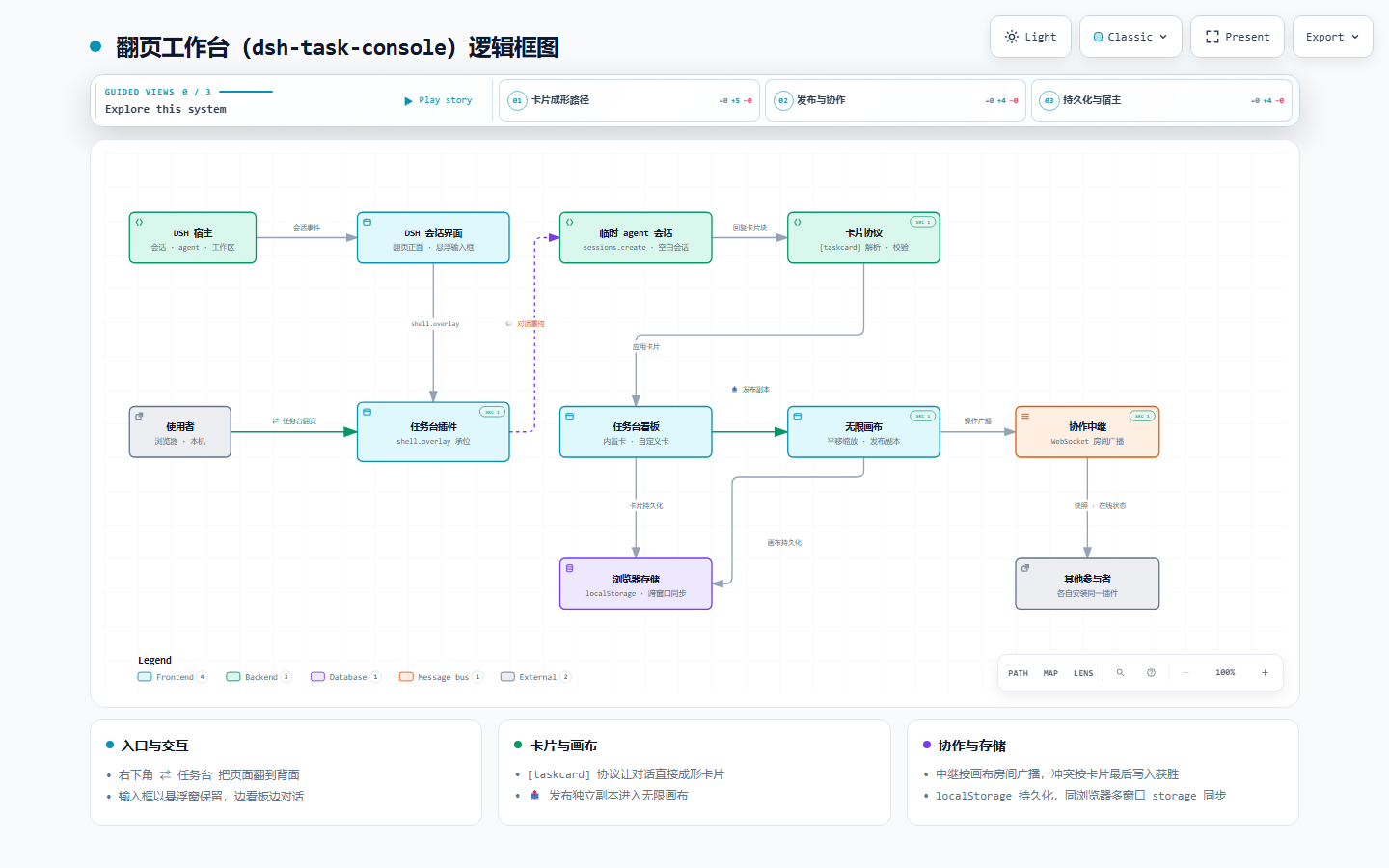
Interactive — the dock embeds the real artifact: wheel-zoom, click a node for details, switch light/dark, guided views, export PNG/SVG. Drag the dock's left edge to resize it (380px – viewport, remembered in
dsh.taskconsole.dockwidth.v1);新标签打开opens it full-screen in a new tab;关闭(or the header toggle) puts it away.No extra files, no network —
docs/architecture.html(~640 KB) is gzipped to ~114 KB and base64-embedded inlib/client.js, decoded lazily on first open withDecompressionStreamand cached for the session. Older browsers withoutDecompressionStreamget a clear message instead of a broken frame.Sandboxed — the frame runs with
sandbox="allow-scripts allow-downloads allow-modals allow-popups"(opaque origin), so the artifact's scripts can render and export but cannot touch the app's DOM or storage.Regenerate — the diagram is generated with the
archifyskill; editdocs/architecture.json(the typed spec) and deliver a new artifact, then re-embed it:archify validate docs/architecture.json --repo-root . # spec checks archify deliver docs/architecture.json --quality showcase --repo-root . node tools/embed-diagram.mjs # gzip + base64 into lib/client.js npm test # asserts the embedded copy == docs/architecture.htmlsmoke.mjsre-computes the sha256 of the decoded payload and compares it withdocs/architecture.htmland with the embeddedTASK_DIAGRAM_SHA256, so a stale embed fails the test.npm run verify:diagramadditionally opens the payload in headless Chrome (skipped when no Chrome is found) to prove thatDecompressionStreamdecodes it byte-identically and that the artifact really renders inside the dock's sandboxed iframe.
Development / 开发
No build step — lib/client.js is both source and shipped bundle (ModuleLoader format, zero dependencies beyond React).
npm i               # react + react-dom for the smoke test
npm run check       # syntax-check the shipped bundle
npm test            # smoke.mjs: SSR-renders the components with fixture state
npm run relay       # start the collaboration relay (relay/server.mjs)
npm run test:relay  # relay protocol smoke test (handshake, ops, presence, token)
node tools/embed-diagram.mjs  # re-embed docs/architecture.html into lib/client.js
npm run verify:diagram        # headless-Chrome check of the embedded diagram frame
npm run verify:embed          # headless-Chrome check of an embedded web app on a card:
                              # sandboxed frames, real grip drag (board + 1.5x plane)
Changelog / 变更记录
Release history: CHANGELOG.md(版本历史见 CHANGELOG.md)。
License / 许可证
MIT © He2way
Operate deliberately
Install and manage
Prerequisites and target Profile
Target: Web Profile
Delivery: Dsh Bundle Git — He2way/dsh-task-console#e745a9e85c24099ee16faffd30cf7f5df84271a2。
Verify, update, and remove
Show lifecycle commands
dsh plugin --profile web listCompatibility and access
DSH web client bundle; Node.js 20+; React 18 peer dependency: Not declared in supplied evidence。
Review compatibility evidence ↗
Risk facts
Persists card layouts, card state, and canvases in browser localStorage.
Evidence ↗User cards can embed external HTTP(S) web apps; embedded sites run their own JavaScript and retain their own cookies and storage.
Evidence ↗Optional collaboration uses a WebSocket relay; its bearer token grants canvas edit access to anyone who holds it.
Evidence ↗Evidence and editorial reviewManifest, Bundle patch, distribution and freshness
Immutable evidence
Review status and source activity
Use the immutable Git source path while npm availability remains unverified.
AI reviewed Sep 16, 2026, 2:12 PM UTC。GitHub facts last checked Sep 16, 2026, 2:12 PM UTC。
No material source change has been recorded since this evidence baseline.