快速了解
它能做什么
用于查看已配置 LLM Provider 余额和用量的可拖动 DeepSeek Harness Web GUI 面板。
本站提供的是中文说明,不代表该项目或 Plugin 自身提供中文界面;语言支持请以上游文档为准。
Web Profile
Not declared in supplied evidence
证据已验证
核对日期 2026/9/12 UTC 14:00
有代码证据的贡献
它为 DSH 增加什么
在 Web GUI 中添加可拖动组件和面板,用于查看余额、用量窗口和 Provider 状态。
机制证据 ↗选择前先看
此 DSH Bundle 会在 Web GUI 中挂载悬浮用量球和面板。它会自动发现当前 Profile 的路由,向受支持的 Provider 查询用量或余额,并将不支持的路由明确标为不支持而非隐藏。
适合谁
适合配置了多个 LLM Provider、希望在会话内查看剩余额度、消费或订阅窗口的 DeepSeek Harness 用户。
常见任务
- 无需逐个打开 Provider 控制台,即可查看 DeepSeek、Moonshot、OpenRouter、Codex 等受支持 Provider 的用量。
- 查看当前会话所选 Provider 是否余额不足或用量窗口接近耗尽。
- 添加兼容的手动网关,并调整刷新间隔和余额告警阈值。
权限与数据
文档说明该插件通过 Harness 凭据服务读取凭据,并发起 Provider 用量查询。
权限- 查询受支持用量时,需要访问已配置的 Provider 路由和 Harness 凭据记录。
- Web GUI 会在 localStorage 中保存组件位置、面板高度、语言、刷新间隔和阈值。
- README 声称 API 密钥按请求解析,不缓存也不写入磁盘。
- OpenAI Codex 的 OAuth 授权信息从 Harness 凭据存储读取,且可能被刷新。
- 项目文档列出的、已配置 LLM Provider 的余额和用量 API 端点。
- 受支持 Provider 通常需要其已配置的 API 凭据;OpenAI Codex 用量需要存于 Harness 的 OAuth 授权记录。
- 文档称 OpenAI 与 Anthropic 成本视图需要管理员密钥。
局限
- 需要已有 DeepSeek Harness 安装;提供的证据未声明 Harness 版本范围。
- 只有列出的 Provider 类型具备用量适配器;其他路由会显示为不支持。
- 提供的记录未审计 npm 包内容,也未执行实际运行时行为。
- README 说明变更插件集合后需要重启 dsh web。
DSHub 已核对
- 已验证不可变 Git 源、包清单和 DSH Bundle Patch 的结构。
- 包声明了 Node ^22.19.0 或 >=24,以及 Cordis、DSH、React 和 Schemastery 的特定 peer dependency。
- Bundle Patch 会将 dsh-provider-usage 插入 Profile,并说明 usage/list 远程服务和 Web GUI 挂载点。
DSHub 未核对
- 未执行安装、Provider API 调用、凭据处理、OAuth 刷新或 UI 行为。
- 未验证其与某个具体 DeepSeek Harness 版本的兼容性。
固定版本安装
安装 DSH Provider Usage
这个Plugin Bundle没有 DSH Plugin 安装操作,请根据源码文档使用真实交付方式。
维护者原文
项目 README
dsh-provider-usage
Every provider's balance, one glance away. A DeepSeek Harness plugin that floats a small draggable usage ball over the Web GUI — no more logging into each provider console to check whether you are about to run out of credit mid-session.
Features
Auto-detection — enumerates the provider routes registered in the current profile (
ctx.llm); zero configuration for well-known routes.Per-kind wire adapters — routes with no public balance/usage API (Google, Mistral, Groq, Bedrock, Azure, Qwen Token Plan, …) are listed as
unsupportedinstead of being silently dropped:kind routes query shows deepseekdeepseek-official,deepseekGET {baseURL}/user/balancetotal / granted / topped-up balance moonshotmoonshotai-cn,moonshotaiGET {baseURL}/users/me/balanceavailable / voucher / cash balance kimi-codingkimi-codingGET {baseURL}/v1/usagesweekly usage + rate-limit windows, reset countdown openrouteropenrouterGET {origin}/api/v1/creditscredits used / total github-copilotgithub-copilotGET api.github.com/copilot_internal/userplan usage snapshots (paid) or monthly usage (free) openai-codexopenai-codexGET {baseURL}/wham/usageChatGPT subscription 5h / weekly windows + credits + spend control (OAuth login, not an API key — see OpenAI Codex via OAuth) openaiopenaiGET {origin}/v1/organization/costscurrent-month spend (admin key required; a regular key fails with 403) anthropicanthropicGET {baseURL}/v1/organizations/cost_reportcurrent-month spend (admin key required, x-api-keyauth)minimaxminimax,minimax-cnGET {origin}/v1/api/openplatform/coding_plan/remainsCoding Plan 5h / weekly remaining % zaizai,zai-coding-cnGET {origin}/api/monitor/usage/quota/limitGLM Coding Plan windows (raw key in Authorization, no Bearer)opencodeopencode,opencode-goGET {baseURL}/usageZen Go rolling / weekly / monthly windows vercel-ai-gatewayvercel-ai-gatewayGET {baseURL}/v1/creditsteam credit balance xaixaiGET {baseURL}/billing/creditsprepaid balance (USD) Credentials stay safe — API keys are resolved per request through the harness credentials service (environment variables /
~/.dsh/.credentials.yaml); never cached, never written to disk. For OAuth providers (OpenAI Codex) the plugin reads the grant record the sign-in flow stored, and refreshes it transparently when it is about to expire.Floating ball widget — a draggable floating ball opens the usage panel. Drop it anywhere in the viewport (position persisted); it docks by default at the bottom-left of the chat area with equal margins, and the panel-header home button sends it back. The panel scrolls when the provider list grows past its height, and its top edge is draggable to resize it taller or shorter (height persisted). The halo around the ball encodes the health of the provider in use — the focused session's own selection (its composer's model seat), tracked live on the client, so switching sessions re-highlights that session's provider immediately without re-selecting a model: green all good, amber when a usage window has under 30% left or a balance below the yellow threshold, red on query failure / missing key / usage ≥90% / balance below the red threshold. Idle providers running low do not color the ball — switch to another provider with enough headroom and the ball turns green again; the panel marks the in-use provider and still lists every provider's numbers.
Version badge — the panel header shows the running plugin version next to the title, so it is obvious which release is loaded.
Bilingual panel — built-in Chinese/English UI; follows the harness language by default, with a one-click toggle in the panel header (persisted in localStorage).
Configurable refresh — adjustable in the panel (15s–30min, persisted in localStorage); the default comes from the plugin config.
Configurable balance thresholds — balance-type providers (DeepSeek, Moonshot, Vercel AI Gateway, xAI) and the
creditsrows of usage-type providers (OpenRouter, OpenAI Codex) turn red below the red threshold and yellow below the yellow threshold, compared in the balance's own currency (defaults: red < 10, yellow < 30, whether CNY or USD). Both values are editable directly in the panel footer (persisted in localStorage); the defaults come from the plugin config. For providers reporting both a subscription plan and credits (e.g. OpenAI Codex), the two are OR'ed: the ball stays green while either one has enough left, and when both are running low the lighter warning wins (the plan is normally consumed before credits).Manual providers — add arbitrary gateways (e.g. a self-hosted DeepSeek-compatible endpoint) via config.
Screenshots
The floating ball (bottom-left, with the green healthy halo) and the open usage panel:
| DeepSeek in use | OpenAI Codex in use |
|---|---|
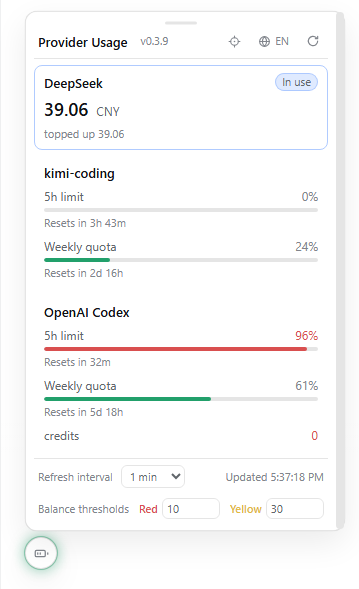 |
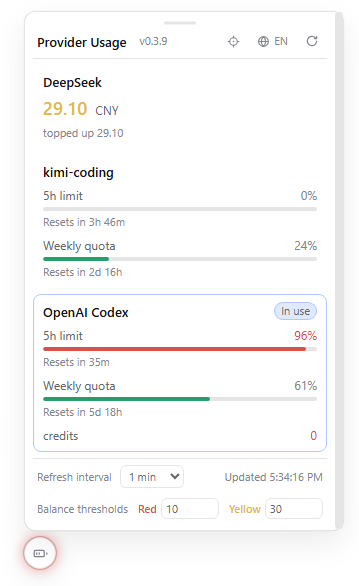 |
OpenAI Codex via OAuth
OpenAI Codex is a ChatGPT-subscription provider: it authenticates with an OAuth access token, not an API key, so there is nothing to paste into a key field. dsh itself has no OAuth button for this route — but this plugin can still query its usage, because it reads the OAuth grant out of the harness credential store. Set the provider up once, and the usage panel shows your real 5-hour / weekly Codex windows.
1. Make sure the route exists
The sign-in writes a grant record addressed llm-pi-ai/openai-codex, and the route has to be configured for ctx.llm to list it. With the stock llm-pi-ai adapter mounted (default in the web profile), an empty profile is enough — e.g. in ~/.dsh/settings.yaml:
llm-pi-ai:
  providers:
    openai-codex: {}
2. Sign in through the harness authorization seam
dsh-llm-pi-ai registers an "OpenAI (ChatGPT Plus/Pro)" OAuth flow for openai-codex on the harness authorization seam (ctx.authorization, credential key llm-pi-ai/openai-codex). Complete it from any surface that runs that flow — a sign-in entry on the harness model/authorization UI, or any pi-ai client whose login persists through the harness credential store. Finish the browser (or device-code) flow with your ChatGPT account. The harness then stores the grant under ~/.dsh/.credentials.yaml as llm-pi-ai/openai-codex:
records:
  llm-pi-ai/openai-codex:
    kind: grant
    payload:
      type: oauth
      access: <access token>
      refresh: <refresh token>
      expires: <epoch ms>
      accountId: <chatgpt account id>
The grant must land in the harness credential store (the record above). Codex clients that keep their own credential file (e.g.
dsh-codex's$DSH_HOME/.openai-codex-auth.json, or the Codex CLI's~/.codex/auth.json) do not write this record, so this plugin cannot see them.
3. Watch the usage
That's it. The route is auto-detected (ctx.llm lists openai-codex), and the plugin:
- reads the grant record from the credential store on every poll (no caching),
- refreshes the OAuth token automatically when it is within 30 s of expiry, deciding and rotating inside the store's exclusive lock — so a concurrent process that already rotated the grant is adopted instead of spending the same single-use refresh token twice, and a write that fails is reported rather than swallowed,
- calls
GET https://chatgpt.com/backend-api/wham/usagewithAuthorization: Bearer <access>and theChatGPT-Account-Idheader derived from the token's own JWT claim, retrying once after a refresh if the endpoint answers401.
The panel then shows your subscription's 5h limit, weekly windows (used %, reset countdown) plus credits and spend control balances when the plan reports them. If the grant is missing the card reads "OAuth authorization missing (llm-pi-ai/openai-codex)" — sign in again with step 2. If upstream instead rejects the stored refresh token (refresh_token_reused / invalid_grant, i.e. the token was already spent or revoked and the rotation never landed here), the card reads "OAuth authorization expired — sign in to Codex again" with the raw upstream detail on hover, and the plugin stops calling the token endpoint for ten minutes instead of once per poll.
4. Troubleshooting: intermittent "Our servers are currently overloaded"
The Codex backend occasionally answers with Codex error: Our servers are currently overloaded. Please try again later., and the harness fails the round with PI_AI_ERROR. This is transient overload on OpenAI's side (account, quota, and network are usually fine — GET /wham/usage confirms window headroom), yet the default configuration never retries, for two reasons:
- pi-ai's Codex client recognizes
overloadedas retryable, but its default retry count is 0 (dsh-llm-pi-aiexplicitly passesmaxRetries: 0); - once the error bubbles up, its text contains no
5xx/rate limit/timeoutkeyword, so it is classified as the catch-allPI_AI_ERROR— which is not amongdsh-llm-retry's default retryable codes (EMPTY_RESPONSE/RATE_LIMIT/SERVER/TIMEOUT/TRANSPORT), so the round fails immediately.
Add a retryPolicy for this provider in ~/.dsh/settings.yaml that includes PI_AI_ERROR in the retryable codes (takes effect on a new session):
llm-pi-ai:
  providers:
    openai-codex:
      retryPolicy:
        mode: normal
        maxRetries: 10
        retryableCodes:
          - EMPTY_RESPONSE
          - RATE_LIMIT
          - SERVER
          - TIMEOUT
          - TRANSPORT
          - PI_AI_ERROR
        backoff:
          initialDelayMs: 2000   # first retry delay, doubled each attempt
          maxDelayMs: 60000      # per-attempt delay cap
          jitterRatio: 0.2       # ±20% jitter
Do not confuse this with the other, deterministic failure: some models are unavailable to ChatGPT-subscription accounts, and the backend answers 400 The '<model>' model is not supported when using Codex with a ChatGPT account. (observed with e.g. gpt-5.3-codex-spark, gpt-5-codex). That is a permanent error — retrying won't help; switch to a model your account supports (e.g. the gpt-5.4 / gpt-5.5 / gpt-5.6 families).
Install
[!NOTE] Requires an existing DeepSeek Harness installation.
npm
dsh plugin --profile web add dsh-provider-usage@latest
Build from source
git clone https://github.com/lizhouai/dsh-provider-usage.git
cd dsh-provider-usage
pnpm install
pnpm build
pnpm pack   # produces dsh-provider-usage-<version>.tgz
dsh plugin --profile web add ./dsh-provider-usage-<version>.tgz
Install the tarball, not the repo directory: dsh plugin --profile web add . links the repo, whose own node_modules then shadows the harness's shared @deepseek-ai/cordis instance and the host half never registers (RPC 404). The link form is still handy for client-only UI iteration — the browser bundle is self-contained, so a rebuild + page refresh picks it up — but switch to the tarball (or the npm release) whenever you need the host half. If pnpm fails with EPERM ... symlink while replacing a linked install, delete the stale node_modules/dsh-provider-usage junction in the profile directory and retry.
Restart dsh web after changing the plugin set (a plugin add/remove requires a restart; afterwards, code changes only need a rebuild + re-add + page refresh).
Upgrade
dsh plugin --profile web add dsh-provider-usage@latest
Then restart dsh web and refresh the page. If the release you want was published very recently, your profile's supply-chain cooldown (minimumReleaseAge) may silently keep the older version — pin the exact version instead (dsh plugin --profile web add dsh-provider-usage@0.3.10) and dsh will exempt it automatically. The version badge in the panel header confirms which release is actually loaded.
Configuration
Defaults work out of the box: the plugin auto-detects every provider route of the active profile. A trusted profile can tune behavior in ~/.dsh/profiles/web/cordis.patch.yml — override the bundle's row by id (the package's own bundle patch already inserts it; a second insert of the same id fails the boot with duplicate loader entry id):
- id: provider-usage
  name: dsh-provider-usage
  config:
    refreshSeconds: 60          # suggested panel refresh interval (5–86400)
    balanceRedThreshold: 10     # balance below this turns red (per the balance's own currency)
    balanceYellowThreshold: 30  # balance below this turns yellow (per the balance's own currency)
    autoDetect: true            # enumerate provider routes from the llm registry
    queryTimeoutMs: 20000       # per-attempt query timeout; each retry gets a fresh timeout
    queryRetries: 2             # retries for transient errors (timeout/network/HTTP 408/425/429/5xx)
    queryRetryDelayMs: 2000     # base retry delay, doubled per attempt, capped at 10s
    providers: []               # manual specs; an id matching a detected route overrides it
| Field | Type | Default | Description |
|---|---|---|---|
refreshSeconds |
number | 60 |
Suggested widget refresh interval in seconds (5–86400) |
balanceRedThreshold |
number | 10 |
Balance below this amount turns red, compared in the balance's own currency |
balanceYellowThreshold |
number | 30 |
Balance below this amount turns yellow, compared in the balance's own currency |
autoDetect |
boolean | true |
Enumerate live provider routes from the llm registry |
queryTimeoutMs |
number | 20000 |
Per-attempt query timeout (1000–120000); each retry gets a fresh timeout |
queryRetries |
number | 2 |
Retries for transient errors — timeout / network / HTTP 408, 425, 429, 5xx (0–10); permanent 4xx errors fail immediately |
queryRetryDelayMs |
number | 2000 |
Base delay between retries (100–60000), doubled per attempt, capped at 10s |
providers |
array | [] |
Manual provider specs: {id, kind, baseURL, apiKeyEnv, displayName?, enabled?}; kind is one of the adapter table above |
The same fields can be hot-updated under the provider-usage: namespace in ~/.dsh/settings.yaml.
Adding a manual provider
config:
  providers:
    - id: my-deepseek-gateway
      kind: deepseek
      baseURL: https://my-gateway.example.com
      apiKeyEnv: MY_GATEWAY_KEY
      displayName: My Gateway
How it works
- Host half (
src/index.ts):UsageService extends TypertRemoteServiceexposesusage/listvia theRemote('list')marker, applied without decorator syntax (SRC mode, no codegen). Config is declared with schemastery, and the settings provider'sinstallSectionenables hot updates from the settings document. - Client half (
src/client/): awindow.__ModuleLoader__.load({id, factory})bundle (built by tsdown) mounts through thesidebar.footer.actionslot (used purely as a mount point — the trigger itself is a floating ball portaled todocument.body) and pollsusage/listthroughctx.connection.rpc.call('/api', 'usage/list', {args:{}})on its own interval. The service stays stateless — every poll fetches live values.
License
有意识地管理
安装与管理
前置条件与目标 Profile
目标: Web Profile
交付方式: Git Bundle — lizhouai/dsh-provider-usage#80db89dc323befecdba8e9fea789c16bd87da6fa。
验证、更新与移除
显示生命周期命令
dsh plugin --profile web list兼容性与访问范围
Requires DeepSeek Harness with the declared Node and peer dependencies.: Not declared in supplied evidence。
风险事实
证据与编辑审查Manifest、Bundle patch、分发与新鲜度
不可变证据
审查状态与源码活动
启用自动轮询前,请在可信的 DSH Profile 中确认该 Profile 可访问哪些 Provider 凭据。
AI 审查于 2026/9/12 UTC 14:01。GitHub 事实核对日期: 2026/9/12 UTC 14:01。
自当前证据基线以来,没有记录到重要源码变化。