快速了解
它能做什么
一个 DSH Bundle,为 treg 外部数据工具目录提供技能及可选 MCP 连接器。
本站提供的是中文说明,不代表该项目或 Plugin 自身提供中文界面;语言支持请以上游文档为准。
dsh Profile
Not declared in supplied evidence
证据已验证
核对日期 2026/9/15 UTC 14:30
选择前先看
Treg 让智能体按要完成的任务搜索托管工具目录,查看端点参数与价格后再调用。此 DSH Bundle 始终提供 treg 技能;只有 dsh 环境中存在 TREG_TOKEN 时才会启用其托管 MCP 连接器。
适合谁
需要 SEO、网页、社交媒体、数据补全、广告或已连接账户数据,并希望避免逐一配置服务商的智能体和团队。
常见任务
- 查找反向链接、关键词量、社交资料或公司数据补全等外部数据能力。
- 在调用前查看端点参数和价格。
- 通过同一注册表令牌使用团队共享工具和已连接账户。
权限与数据
可选连接器会向 treg 托管 MCP 端点发送 Bearer 令牌;目录调用可访问当前组织可用的工具。
权限- 启用 MCP 连接器需要读取环境变量 TREG_TOKEN。
- 启用连接器后需要访问 https://treg.to/mcp/。
- 随附技能声明凭据在服务器端注入,调用按当前组织隔离。
- treg.to 托管 MCP 服务及其目录端点。
- DSH MCP 连接器需要 TREG_TOKEN。
局限
- 未设置 TREG_TOKEN 时,MCP 连接器保持禁用。
- 该包未捕获到安装脚本。
- 提供的证据未声明 Harness 版本范围。
- 目录调用可能计费,调用前应查看列出的价格。
DSHub 已核对
- 源提交已固定。
- 包结构和 DSH Patch 已验证。
- Patch 会有条件地配置指向 https://treg.to/mcp/ 的流式 HTTP MCP 连接器。
DSHub 未核对
- 未在真实 DSH Profile 中执行安装。
- 未独立测试运行时 MCP 连通性、认证、可用端点或价格。
固定版本安装
安装 treg
这个Plugin Bundle没有 DSH Plugin 安装操作,请根据源码文档使用真实交付方式。
维护者原文
项目 README
Treg (OpenRouter for Tools)
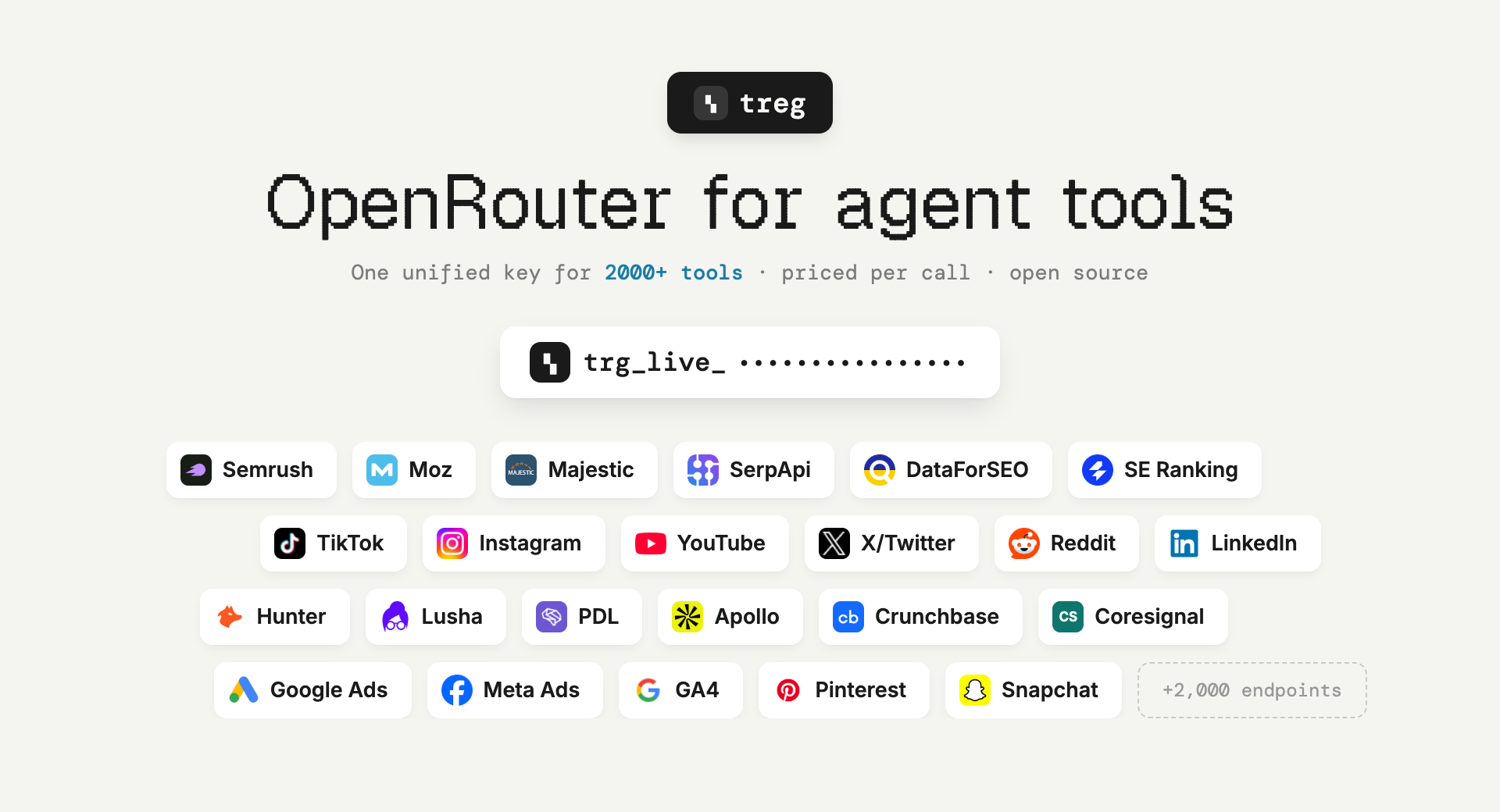
OpenRouter, but for agent tools instead of models. Point an agent at one base URL with one token and it can do the job: 3,000+ catalogued endpoints across 60+ providers — SEO and backlinks, social and trends, people and company enrichment, ads, scraping — priced per call, from a cent, with no provider signup. Plus your own team's keys, skills and CLIs, callable by every teammate's agent without the credential ever leaving the server.
Ask for the task, not the tool. You do not need to know which vendor sells backlink data, or to hold an account with them. Search for what you want to do, read the price, call it.
Built for the Superdesign team, live at treg.to — anyone can self-host.
Why it exists
The tools an agent needs for real work sit behind subscriptions nobody buys for a single run — Semrush $139/mo, Moz $99/mo, Crunchbase $99/mo, Apollo $59/seat — behind signup walls, or behind no public API at all (invite-only, partner-only, app-review-only). treg carries those accounts and bills fractions of a cent per call.
Two kinds of tool, one token
- The catalog — external endpoints treg can serve with its own key or through a verified public route that needs no provider key. Own-key calls use the team's prepaid balance; anonymous calls are free. No account with the provider is needed. New verified accounts receive $1.00 free once, when they create an eligible team.
- Your own tools — anything a teammate registered: a paid API account, an OAuth connection, a
vendor CLI, a
SKILL.md. Your own key always wins over treg's, and those calls are never metered.
The vocabulary for the second half:
- tool = something the registry calls for you with the org's credential. Two kinds:
- endpoint — an upstream
base_url+ credential bindings (each binding injects one secret into the request; a request can carry several, e.g. an OAuth bearer and adeveloper-tokenheader). - CLI — a vendor binary (
stripe,gh,vercel, ...) run with the credential injected.
- endpoint — an upstream
- skill / bundle = a recipe (
SKILL.md) + its secrets + its tool(s), registered together.
The one rule: the proxy relays, never models the upstream, and injects auth server-side — so it survives upstream API changes and callers never hold keys.
Part 1 · Using the registry
Visit treg.to (hosted on Render) — the dashboard, sign-in, and every URL below live there.
Quickstart
Same flow as the dashboard's Getting started guide:
# 1. install the CLI — also points it at the registry
curl -fsSL https://treg.to/install.sh | sh

# 2. sign in (GitHub default · --email for a one-time code · --token for agents/CI)
treg login

# 3. do something useful immediately — no key, nothing registered
treg catalog search "backlinks for a domain"     # find a tool by what it DOES
treg call tikhub.tiktok.user.profile --query uniqueId=tiktok
treg balance                                     # exactly what that cost

# (or `treg onboard` for the guided walkthrough)
Catalog tool inputs are described by treg catalog get <id>. Tools marked strict_query reject undeclared or repeated query parameters, unsupported values and request bodies.
Your token identifies you on every call (X-Treg-Token header) and is the same for all tools.
Discover what your team has shared: treg tool ls · check credential health: treg health.
Or install it as a Claude Code plugin
/plugin marketplace add superdesigndev/treg
/plugin install treg@treg
Installs with no token and no configuration. The skill loads as treg:treg and, on its first run,
walks your agent through the rest — the CLI, sign-in, then treg mcp install — so you end up with
the command line and treg's tools. Other agents: npx skills add superdesigndev/treg -s treg
(the -s matters — without it you also get this repo's internal dev skills).
See docs/CLAUDE-PLUGIN.md. MiniMax Code / MiniMax Agent users: the same
skill ships via the MiniMax Plugin Marketplace (docs/MINIMAX-PLUGIN.md).
Claude.ai connector
The Claude Connectors Directory surface is https://treg.to/mcp/v2/. It exposes only curated
catalog endpoints and separates read calls from write calls so Claude receives accurate safety
signals. The existing /mcp/ surface remains available for catalog endpoints, team-owned tools,
and imported skills. See the MCP and OAuth architecture
for the boundary and implementation, and the
submission runbook for release gates.
Call a tool you don't have a key for
The catalog is grouped by what endpoints do: keyword and rank tracking, backlinks and authority, AI visibility, trending and discovery, publishing to socials, people and company enrichment, ads management and creative, measurement.
treg catalog                                    # every platform, busiest first
treg catalog search "find a work email"         # by the job, not the vendor
treg catalog get hunter.people.email.find       # params, PRICE, example response
treg call hunter.people.email.find --query domain=reddit.com --query full_name="Alexis Ohanian"
How a catalogued call is served — the credential ladder, in order:
- your team registered its own tool for that provider → that tool, that key;
- your team stored a secret for the provider → injected through a virtual tool;
- neither, and the endpoint has a verified public route → no provider key, free;
- otherwise → treg's own key, billed to the team's prepaid balance.
The anonymous price assumes the caller does not send a provider credential header. The faithful
relay preserves caller headers, so a caller-supplied provider key can use that key's credits.
Your own credential always beats treg's, so connecting a key you already pay for makes those calls
free of the balance rather than duplicating them. An endpoint treg has no published price for is
refused, not served free — you are told to connect your own key instead. Where several providers
serve one capability, treg catalog search shows them side by side with prices; choosing is
yours — treg does not silently pick or fail over between providers for you. (When treg's own
account for a provider is out it may serve the same endpoint through a treg-owned relay account,
disclosed on the response; a team can opt out.) The exception you opt into: treg.<capability> routed endpoints, where treg picks the provider for you and names it.
treg balance          # credit left, calls in flight, recent spend
treg topup            # add funds, or set up automatic top-ups
Out of balance is an HTTP 402 carrying balance_micro, estimated_cost_micro and a topup_url,
so an agent can act on it without reading prose.
Enrich Arena lives at /enrich-arena, outside the dashboard. Compare enrichment answers with each vendor’s cost and speed,
vote for the best answer in one click, or watch a sequential waterfall. Browsing is
public; submitting requires login, and billable attempts use your team's credits. See the
Arena guide.
Share & use your own tools
The zero-thought path — point treg at a project and it figures out what's shareable:
treg scan     # read-only preview: the keys, skills & CLIs upload would register
treg upload   # register them (encrypted server-side); idempotent, --replace to update
treg upload scans the .env (matching keys against ~80 known providers), every skill
subdirectory, and installed catalog CLIs. Three kinds of things go into the registry — here's how
to share and use each:
1. Endpoints (HTTP APIs)
Share — one upstream URL callable with a stored key, or bulk from a .env:
treg secret add STRIPE_KEY --value sk_live_123
treg add stripe --base-url https://api.stripe.com --secret STRIPE_KEY

treg upload env --select openai,stripe,resend     # or straight from the .env
Use — the agent-native way: build the real upstream request and prefix it with the proxy.
treg resolves the tool by host, injects the credential, and relays everything else faithfully
(your X-Treg-Token is stripped before the upstream sees it):
Real request:   GET https://api.intercom.io/conversations?per_page=5
Through treg:   GET https://treg.to/call/https://api.intercom.io/conversations?per_page=5
                    header:  X-Treg-Token: <your token>
Or the CLI shorthand — and treg calls for the audit log:
treg call intercom conversations --query per_page=5
treg call stripe v1/balance
2. CLIs
Share — automatic: treg upload detects installed catalog CLIs (stripe, gh, vercel, …)
and registers them; a recipe-only catalog CLI skill (e.g. stripe-cli) auto-becomes runnable too.
Use — treg run executes the vendor CLI with the org's credential injected, so you never
hold the key or log in:
treg run stripe -- get /v1/balance
treg run gh -- pr list
treg run --server agentmail-cli inboxes list   # runs on the registry server: the key never reaches you
--local (default) runs on your machine; --server runs on the registry and streams output back.
For a whole session, treg shell start opens a subshell where every registered CLI injects
automatically — just use stripe, gh, … normally; exit reverts. treg runs is the audit log.
3. Skills
Share — a skill is a whole capability (SKILL.md recipe + its secrets + its tool(s)),
registered together so the whole team runs the same skill, maintained in one place:
treg upload skills --dir ~/.claude/skills --all # register a folder of skills in one pass
Use — pull any shared skill into your agent; its API calls go through treg with your token, so the key stays on the server, never in the skill:
treg skill install seo-blog-writer # writes into ./.claude/skills/ (--all for the library)
Manual registration — when the heuristics can't figure a tool out
# multi-credential tool (e.g. google-ads: OAuth bearer + a developer-token header)
treg tool add google-ads --base-url https://googleads.googleapis.com \
  --bind "secret=<oauth-id>,injector=oauth" \
  --bind "secret=<dev-id>,name=developer-token,format={secret}"

# one skill, step by step
treg skill init --dir ./my-skill          # drafts treg.json (guesses base_url, finds secrets)
treg skill add  --dir ./my-skill          # registers recipe + secrets + tool, atomically

# OAuth via the browser (mints the first token, treg holds it and auto-refreshes)
treg oauth connect gsc --client-secret client_secret.json \
  --scopes https://www.googleapis.com/auth/webmasters.readonly
Full options for every command: USAGE.md.
The CLI sends anonymous command usage to PostHog when using treg.to (no arguments or credentials).
Disable with TREG_TELEMETRY=0 or DO_NOT_TRACK=1.
See analytics details.
Teams
An account can own up to 10 teams. Joining other teams as a member does not count toward this limit.
Everything is scoped to an org: a token = a (user, org) membership, and every secret, tool,
and skill belongs to the active org. Roles: owner / admin / member / viewer.
treg org create "Acme"                        # make a team, become owner
treg org invite teammate@acme.com             # invite by email (pick role + tool access)
treg org join <code> --email you@acme.com     # accept an invite (creates you if new)
treg org ls | use <slug> | members            # switch orgs, see the roster
treg org access <member> --tools a,b          # per-member tool access (admin+)
Going deeper
Feedback:
treg feedback submit friction "The pagination example is unclear."Share problems or suggestions without private information. See feedback instructions.Review:
treg review CALL_ID usefulRate an invited catalog call after using its result;not_sureis fine. Omit private data and continue the task.USAGE.md— the fulltregCLI reference./llms.txt— the agent-onboarding file: call protocol, discovery, auth, CLI, skills. One fetch teaches an agent the whole registry.The dashboard at treg.to — full CRUD, a guided tutorial (Help → Tutorial), and copyable setup instructions for your agents.
The API — everything the CLI does is plain HTTP; interactive OpenAPI docs live at
/docs. The proxy endpoint is/call/{...}; all endpoints take theX-Treg-Tokenheader.
Part 2 · Self-hosting & development
Run it locally
One command (needs tmux + uv; it syncs the venv itself):
scripts/dev-local.sh up # server on http://localhost:18790, dev-safe settings
That runs the server in tmux with hot-reload, its own sqlite DB (treg-dev.db), and email OTP dev
mode (sign-in codes shown on the page — no mail sender needed). Day-to-day:
scripts/dev-local.sh cli login   # sandboxed CLI: never touches your real ~/.treg/config.json
scripts/dev-local.sh logs        # server output          · status / restart / down
scripts/dev-local.sh reset       # wipe the dev DB + CLI sandbox for a fresh start
Or run the server directly, without tmux:
uv sync                        # create the venv from uv.lock (pulls the server deps for dev)
uv run python -m treg upgrade  # prepare schema + run idempotent release tasks without serving
uv run python -m treg          # serve on 0.0.0.0:18790 (add --reload for dev)
uv run python -m treg keygen   # print a fresh Fernet key for TREG_SECRET_KEY
Installing to run a server (not from source): the base package is the CLI only. To run a registry, install the server extra —
pip install "tools-registry[server]"— which adds FastAPI, the database drivers, and encryption.pip install tools-registryalone gives just thetregcommand for talking to an existing registry.
The official hosted service is available at treg.to. Its production topology and live settings are
maintained in the private operator runbook.
Configuration
Environment variables (prefix TREG_, read from .env):
| Var | Default | Purpose |
|---|---|---|
TREG_DATABASE_URL |
sqlite+aiosqlite:///./treg.db |
DB URL (SQLite for dev, Postgres in prod) |
TREG_SECRET_KEY |
(empty) | Fernet key for secrets-at-rest; empty → an ephemeral key is minted (secrets won't survive a restart) |
TREG_PUBLIC_URL |
https://treg.to |
treg's public base, used to build the OAuth callback URI |
TREG_SESSION_SECRET |
(empty) | signs the dashboard session cookie; falls back to TREG_SECRET_KEY. Set a real value in prod |
TREG_GITHUB_CLIENT_ID / _SECRET |
(empty) | GitHub OAuth sign-in (callback <public_url>/auth/github/callback); empty hides the button |
TREG_GOOGLE_CLIENT_ID / _SECRET |
(empty) | Google OAuth sign-in (redirect <public_url>/auth/google/callback); empty hides the button |
TREG_INSTAGRAM_CLIENT_ID / _SECRET |
(empty) | Instagram App ID and secret for direct Instagram Login (redirect <public_url>/oauth/callback) |
TREG_META_CLIENT_ID / _SECRET |
(empty) | Meta app credentials for Facebook Pages, Meta Ads, and optional Instagram page-tools |
TREG_OAUTH_REVIEW_PENDING |
instagram-login,page-messages |
Comma-separated registry review keys whose capabilities must remain gated; hosted review state is maintained privately. |
TREG_RESEND_API_KEY / TREG_EMAIL_FROM |
(empty) | transactional email via Resend (OTP codes + invites); From must be a Resend-verified sender |
TREG_BLOCKED_EMAIL_DOMAINS |
(empty) | comma-separated email domains refused at every sign-up/sign-in door and at team creation (subdomains included, case-insensitive). Empty blocks nothing — no list ships in the code |
TREG_ADMIN_TOKEN |
(empty) | cross-tenant super-admin bearer; authorizes every /admin/* endpoint. Empty disables the env path (only is_superadmin users reach /admin). Keep it long + secret. |
TREG_EMAIL_DEV_MODE |
false |
when true, /auth/email/start returns the OTP in its response (no mail sender needed) — dev/local only, never in prod. |
TREG_KV_URL |
(empty) | shared key-value store (Redis protocol) for counters every worker must agree on, today the per-team review-invitation budget. Empty = an in-process fallback, fine for one worker |
No .env is needed for local dev — every setting has a working default (ephemeral key, sqlite).
⚠️ Back these up before moving or redeploying: the Fernet key (
TREG_SECRET_KEY) and the database (Postgres in prod;treg.dbfor a local sqlite run). Lose the Fernet key and every stored secret becomes unrecoverable.
Architecture
Request flow for /call: resolve tool (by URL host + longest base_url prefix, or by name) →
decrypt its secret(s) → apply each binding's injector → stream to the upstream → fire-and-forget
audit record. The infra relay streams bytes without business logic. The call application buffers
responses needing settlement or ownership evidence up to 8 MiB; larger responses return a 502
without charging instead of a truncated success. Authorized free final downloads needing no body
evidence stream in full, as do own-key and own-tool responses.
Module map (src/treg/):
| Module | Role |
|---|---|
proxy.py |
relay() — the whole product in one function: a faithful streaming proxy |
injectors.py |
the auth-shape seam: env, cli_auth, secret_file, oauth place a secret into a header/query |
oauth.py |
token freshness (single-flight refresh) + the connect flow (consent URL, code exchange) |
health.py |
credential health: refresh oauth, probe tools, webhook the owner of anything broken |
convert.py |
scaffold a skill directory into a registerable bundle manifest |
api.py |
the API — the only brain; CLI + skill are thin clients over it |
cli.py |
the treg CLI |
models.py |
SQLModel tables: Org, User, Membership, Invite, Secret, Tool, Bundle, PendingOAuth, CallRecord |
crypto.py config.py db.py audit.py |
Fernet encryption + tokens · settings · async DB · deferred audit writer |
The 4 auth shapes (per binding injector): env (plain string / API key) · secret_file (a
JSON token file, pull a field) · oauth (a JSON OAuth token, auto-refreshed if refreshable) ·
cli_auth (material lifted from a CLI's keychain).
Faithful-relay contract: the proxy alters only three things, everything else is verbatim:
- hop-by-hop transport headers (re-derived per hop),
- treg's own control + edge-forwarding headers (
x-treg-token,x-treg-org,ngrok-skip-browser-warning,x-forwarded-*,via, …) and treg's session cookie — all stripped, never leak upstream, - the injected credential(s).
OAuth, three ways to get the first token: manual upload (drop in a token.json) ·
auto-refresh (if the token carries refresh_token + client creds, treg keeps it fresh, you never
re-upload) · hosted connect flow (treg oauth connect → browser consent → treg captures the
token itself).
Health checks: give a tool an optional probe ({method, path, expect_status}); a periodic run
(on demand or via cron) validates every credential, refreshes OAuth, and webhooks the owner of any
that break.
Deep design lives in docs/context/ (per-subsystem fragments).
Tests
uv run --with pytest-xdist pytest -n auto -q   # daily local default (same shape as CI)
uv run --frozen python -m pytest -q            # serial: debugging one test, or order
Coverage: proxy walking-skeleton, all injector shapes, per-user auth + CRUD + audit, skill composer,
URL-passthrough + faithful relay, OAuth refresh + connect flow, health checks, treg run/shell,
upload/scan, orgs + invites, the dashboard API, CLI.
Contributing & docs
treg/
├── src/treg/            # the package (api, cli, proxy, injectors, oauth, health, convert, models, …)
│   └── web/             # dashboard, landing, tutorial, llms.txt, skill.md, install.sh
├── tests/               # pytest suite (CI + local default: pytest-xdist -n auto)
├── docs/
│   ├── context/         # design fragments (codemap system) + generated index
│   └── ONBOARDING.md    # first-time bootstrap
├── USAGE.md             # full treg CLI reference
└── pyproject.toml
Per-subsystem design docs are fragments in docs/context/, each citing its src/treg/*
sources. Working in this repo with an AI agent? The /tools-registry-context skill loads the
right fragment for what you're touching and keeps the docs in sync — run
/tools-registry-context sync before pushing.
Roadmap: MCP support · finer permission tiers · at-rest key-management hardening · possible Loopni merge.
License
Apache 2.0 with additional terms (LICENSE): use it freely — including commercially,
inside your own organization (self-hosting your own registry is encouraged). The restriction: don't
redistribute the code to third parties as a competing hosted/managed registry service without written
permission (jason@superdesign.dev). Using the hosted treg.to API inside your own product —
with pass-through billing via X-Treg-Meta and usage/by-tag — is allowed without permission;
that's calling our API, not redistributing our software.
有意识地管理
安装与管理
前置条件与目标 Profile
目标: dsh Profile
交付方式: Git Bundle — superdesigndev/treg#3d1d9240ea94c5b08a4a724714becd081162d53e。
验证、更新与移除
显示生命周期命令
dsh plugin --profile dsh list兼容性与访问范围
DSH bundle patch verified; MCP activates when TREG_TOKEN is set: Not declared in supplied evidence。
风险事实
证据与编辑审查Manifest、Bundle patch、分发与新鲜度
不可变证据
审查状态与源码活动
请使用不可变 Git Bundle,不要依赖未找到的 npm 包版本。
AI 审查于 2026/9/15 UTC 14:31。GitHub 事实核对日期: 2026/9/15 UTC 14:31。
自当前证据基线以来,没有记录到重要源码变化。