At a glance
What it does
A DSH settings plugin for reasoning effort with custom LLM providers.
Web Profile
not tested
Evidence-verified
Checked Aug 28, 2026, 9:01 AM UTC
Code-evidenced contributions
What it adds to DSH
Provides reasoning effort settings based on the pinned repository evidence.
Mechanism evidence ↗Before you choose it
This Bundle provides a DSH settings plugin for reasoning effort with custom LLM providers.
Best for
DSH users who need configuration capabilities in a web profile.
Common tasks
- Use DSH Reasoning Settings for configuration workflows.
- Review the pinned repository evidence before deciding whether it fits your profile.
Permissions and data
This Bundle changes the DSH profile composition and may use host capabilities exposed by its dependencies; runtime behavior was not tested in this run.
Permissions- Adds a DSH Bundle to the web profile.
- Runtime data handling was not tested in this run.
- May use dependencies declared by the pinned manifest.
- No credential requirement was established by the supplied evidence.
Limitations
- Runtime installation and execution were not tested in this run.
- The semantic description is based on repository evidence and is not a security certification.
What DSHub checked
- The source repository commit is pinned in the evidence.
- The Bundle manifest and patch structure are present.
What DSHub did not check
- Runtime installation, execution, and compatibility were not tested in this run.
- No security certification is implied.
Pinned install
Install DSH Reasoning Settings
This plugin bundle does not have a DSH Plugin install action. Use its source documentation for the delivery method.
Maintainer source
Project README
DSH Reasoning Settings
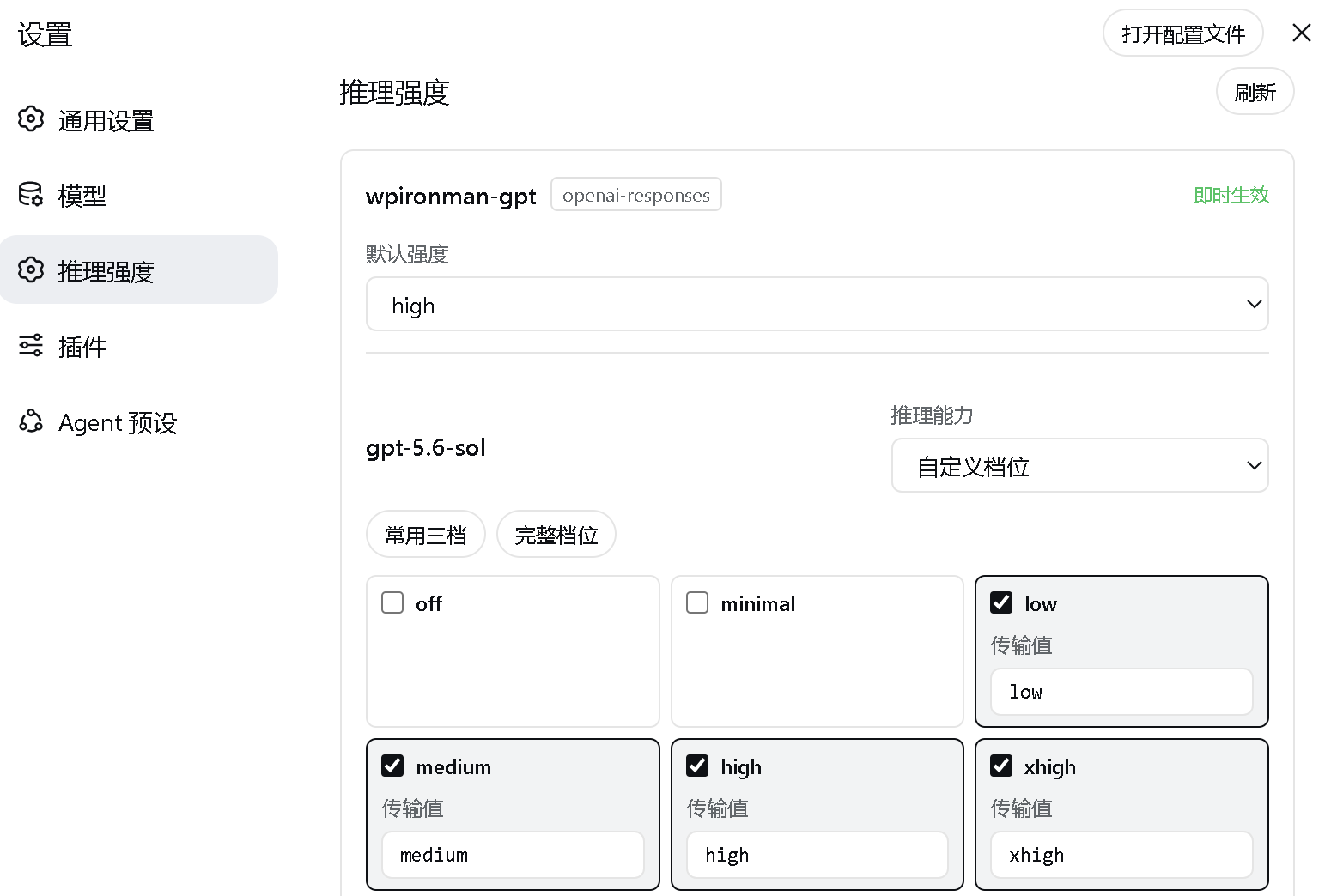
A DeepSeek Harness Web settings plugin that adds an independent reasoning effort (thinking intensity) page for custom llm-pi-ai providers. The official UI only exposes effort selection for first-party DeepSeek models; this plugin makes it work for third-party / relay APIs too.
Third-party service recommendation (referral link)
If you are looking for an OpenAI-compatible API relay, you can take a look at WPIronman API. This is my referral link, and I may receive a referral benefit if you register through it; any promotion or benefit is subject to the provider's current terms. This plugin is independent of that service and does not require any particular relay. Evaluate pricing, reliability, and privacy terms before choosing a provider.
New users can redeem the gift quota with code
99F509ABC6C38F77.
Features
- Auto-reads the custom providers and models you already added on the official Models page.
- Declares a per-model effort level from
off / minimal / low / medium / high / xhigh / max. - Customizes the actual wire value sent to the API for each level.
- Sets a provider-wide default effort, restricted to the levels supported by every model in that provider.
- Configures the reasoning wire format for
openai-completionsproviders. - Writes back to
llm-pi-ai.providers.*through the officialsettings.mutateAPI — API keys are never touched. - Fixes in-process subagents inheriting the Agent's create-time official model instead of the parent's live third-party provider/model selection.
- Makes subagents inherit an explicit parent reasoning effort, or fall back to the target provider's configured default effort.
- Resolves model-only child overrides such as
grok-4.5against user-configured third-party providers instead of an unrelated official provider. - Extends the ordinary
subagentandsubagent_forktools with per-callprovider,model, andreasoning_effortfields, without replacing their official lifecycle, background, or result behavior.
Live demo
Installation
Prerequisites
- Install Node.js. DSH currently supports Node.js 22.19.x or version 24 and newer; Node.js 24 LTS is recommended. Node.js includes
npmandnpx. - Install Git so the plugin can be fetched from its GitHub repository.
- Install pnpm. Both methods require pnpm because
dsh plugininvokes it in the profile directory to install or remove plugins. - Your network must reach
registry.npmjs.organdgithub.com. Configure a working network proxy if npm or GitHub is unavailable or unstable in your region. - Method 1 does not require a DeepSeek Harness source checkout. Method 2 additionally requires that checkout.
Check the basic environment first:
node --version
npx --version
git --version
corepack enable
pnpm --version
If corepack enable fails with a permission error, run it once from an Administrator PowerShell. Alternatively, use another option from the pnpm installation guide.
If downloads remain on a spinner or fail with ECONNRESET, ETIMEDOUT, or a GitHub connection error, set a proxy for the current PowerShell window. Port 7890 is only an example; replace it with your proxy's actual port:
$proxy = "http://127.0.0.1:7890"
$env:HTTP_PROXY = $proxy
$env:HTTPS_PROXY = $proxy
$env:npm_config_proxy = $proxy
$env:npm_config_https_proxy = $proxy
These variables only affect the current PowerShell window and disappear when it is closed.
Method 1: npx (recommended for regular users)
This method does not require a DeepSeek Harness source checkout or a global dsh installation, but Git and pnpm must already be available. On its first run, npx downloads @deepseek-ai/dsh and its dependencies, which can take several minutes:
npx --yes -p @deepseek-ai/dsh dsh plugin --profile web add github:JuneLearn/dsh-reasoning-settings
Start Web through the same package runner after installation:
npx --yes -p @deepseek-ai/dsh dsh web
Method 2: pnpm with the Harness source tree (recommended for developers)
Use this method if you already cloned deepseek-harness and want to run its source directly. First confirm pnpm is available:
pnpm --version
Enter the DeepSeek Harness source root. Install its dependencies once, then install the plugin:
cd D:\deepseek-harness
pnpm install
pnpm dsh plugin --profile web add github:JuneLearn/dsh-reasoning-settings
Start Web from that source directory afterward:
cd D:\deepseek-harness
pnpm dsh web
The package's dsh.bundle declaration adds the plugin to the Web profile automatically. Neither method requires editing cordis.patch.yml. Web listens on http://127.0.0.1:3080 by default; it uses another port only when the default is occupied or you explicitly select one.
Upgrade
Run the corresponding install command again to upgrade. No uninstall or profile-patch maintenance is required.
npx method:
npx --yes -p @deepseek-ai/dsh dsh plugin --profile web add github:JuneLearn/dsh-reasoning-settings
pnpm source method:
cd D:\deepseek-harness
pnpm dsh plugin --profile web add github:JuneLearn/dsh-reasoning-settings
Uninstall
npx method:
npx --yes -p @deepseek-ai/dsh dsh plugin --profile web remove dsh-reasoning-settings
pnpm source method:
cd D:\deepseek-harness
pnpm dsh plugin --profile web remove dsh-reasoning-settings
DSH removes both the dependency and its bundle layer. Restart dsh web; the Reasoning effort settings page is removed.
Usage
- Add your custom provider and models on the official Models page first.
- Open Settings > Reasoning effort.
- Pick the supported levels for each model and set the provider default effort.
- Click Save under that provider.
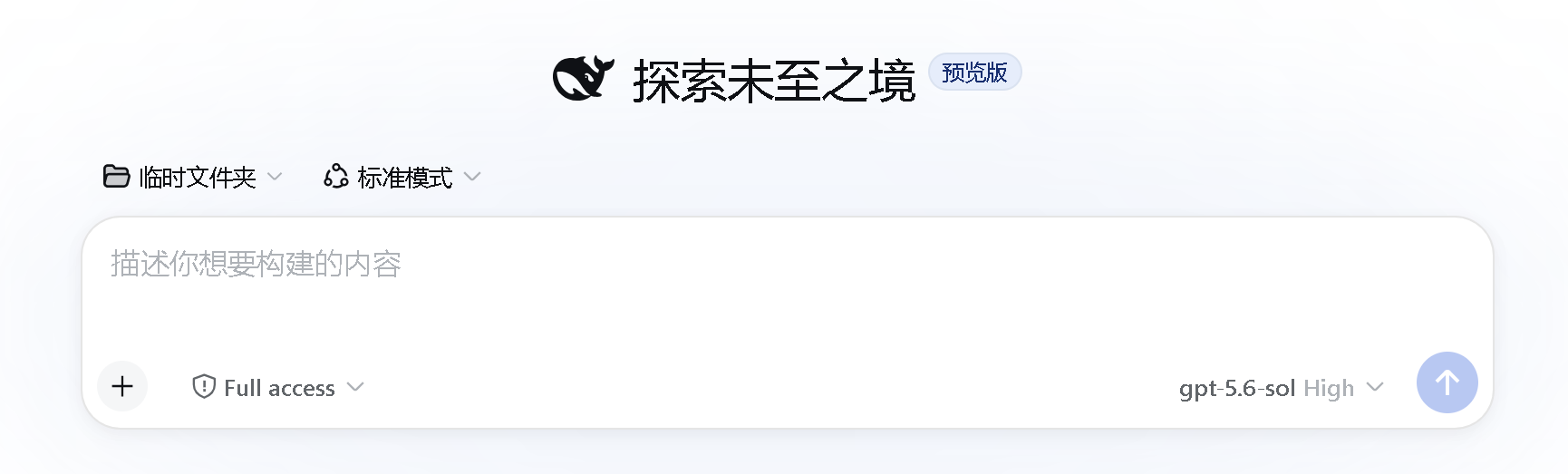
- Start a new session and choose the model and reasoning effort in the model picker.
The plugin only declares which effort levels Harness may select and send. Whether the relay API actually honors a value is up to the relay: if a request comes back with HTTP 400, uncheck the levels that model does not support or adjust their wire values.
Subagent routing and reasoning
The server entry fixes model inheritance for Harness 0.1.0-rc.5 in-process subagent, subagent_fork, and Workflow children:
- An explicit child
provider + modelroute remains authoritative when it differs from the parent's create-time route. - A model-only override is resolved against user-configured third-party providers; duplicate model ids prefer the parent's current provider.
- With no child override, the child inherits the parent's live provider/model instead of its create-time official default.
- An explicit child effort remains authoritative; otherwise the parent's effort is inherited only for the same target route.
- With no explicit effort, the plugin leaves it absent so
llm-pi-aiapplies the target provider'sreasoningdefault.
The plugin also augments the existing model-facing subagent and subagent_fork tools for each live Agent. Their original arguments remain available, with three optional fields added:
provider: exact configured Provider id;model: exact model id owned by that Provider;reasoning_effort: optionaloff / minimal / low / medium / high / xhigh / maxlevel.
provider and model must be supplied together. Omitting both preserves normal inheritance. Omitting reasoning_effort after selecting a different route uses that Provider/model's configured default. The tool descriptions enumerate exact configured pairs and instruct the parent model to delegate instead of answering directly when a user requests another Provider/model.
Do not use shorthand such as “the 5.6 model” when multiple exact ids exist. For example, if a Provider contains both gpt-5.6-sol and gpt-5.6-terra, ask for one exact pair:
Use subagent with provider=wpironman-gpt, model=gpt-5.6-terra,
reasoning_effort=max to write a 100-character random essay.
If the requested pair equals the current route, the child still uses that same route, so the result will naturally look like the parent model. The structured tool-call arguments and the child's durable request/header are the reliable verification points.
Per-call targeting affects local in-process children only. Codex, Claude Code, and ACP subagents run in separate processes and retain their own model configuration. Workflow retains its own structured provider/model phase fields and still benefits from the inheritance correction when no phase target is supplied.
All switches default to true and may be changed in the plugin mount:
- insert:
    - id: ui-settings-reasoning
      name: dsh-reasoning-settings
      config:
        subagentRouting: true
        inheritRoute: true
        resolveModelOnly: true
        inheritReasoning: true
Set subagentRouting: false to disable the entire server-side correction.
Development
pnpm test # or: node tests/plugin.test.mjs
Compatibility
Built against the public dual-end plugin, settings-slot, settings.mutate, agent-scoped tool shadowing, Agent lifecycle, and agent/request waterfall interfaces of DeepSeek Harness 0.1.0-rc.5. Harness is still in Developer Preview; if the plugin stops loading or subagent routing changes after an upgrade, check those interfaces and the subagent session metadata.
License
Operate deliberately
Install and manage
Prerequisites and target Profile
Target: Web Profile
Delivery: Dsh Bundle Git — junelearn/dsh-reasoning-settings#25b6ee69fe717414cd1c6f3b1c39b5e62a8e99c9。
Verify, update, and remove
Show lifecycle commands
dsh plugin --profile web listCompatibility and access
Not_runtime_tested: not tested。
Review compatibility evidence ↗
Risk facts
No installer script was captured; review the repository instructions before use.
Evidence ↗The npm distribution signal is incomplete or differs from the pinned source; review the Git Bundle path before use.
Evidence ↗Evidence and editorial reviewManifest, Bundle patch, distribution and freshness
Immutable evidence
Review status and source activity
Approved for publication after reviewing the source-linked content and immutable release record. AI assisted with the draft; the publication decision was human.
Human reviewed Aug 30, 2026, 8:24 AM UTC。GitHub facts last checked Aug 29, 2026, 3:21 PM UTC。
No material source change has been recorded since this evidence baseline.